Winter in Ireland
Your Complete Guide to Visiting in December, January & February
Winter is Ireland’s most underrated season. While most visitors flock to the Emerald Isle in summer, those who choose to visit in the colder months discover a very different Ireland.
Ireland in winter is quieter, more atmospheric, and in many ways more authentically itself. Cozy pubs with open fires, dramatic winter coastlines, empty roads through spectacular landscapes, and Christmas celebrations that feel genuinely magical.
One of my favorite things about these colder months in Ireland is venturing to a pub for a warming dinner and a drink in one of the great social institutions of the world.
This guide covers everything you need to know about visiting Ireland in winter, including what December, January, and February are actually like, what Christmas in Ireland looks and feels like, whether it snows, and how to make the most of a winter visit to the Emerald Isle.
Who This Winter in Ireland Guide is For
This guide is written for:
- Visitors planning a Christmas trip to Ireland who want to know what to expect and how to plan
- Budget-conscious travelers who want to experience Ireland at its most affordable, with off-peak prices and availability
- Anyone wondering if Ireland is worth visiting in winter — the answer is yes, and this guide explains why
- Visitors curious about Irish winter weather and whether it snows
- Anyone planning a January or February trip who wants honest, practical month-by-month guidance
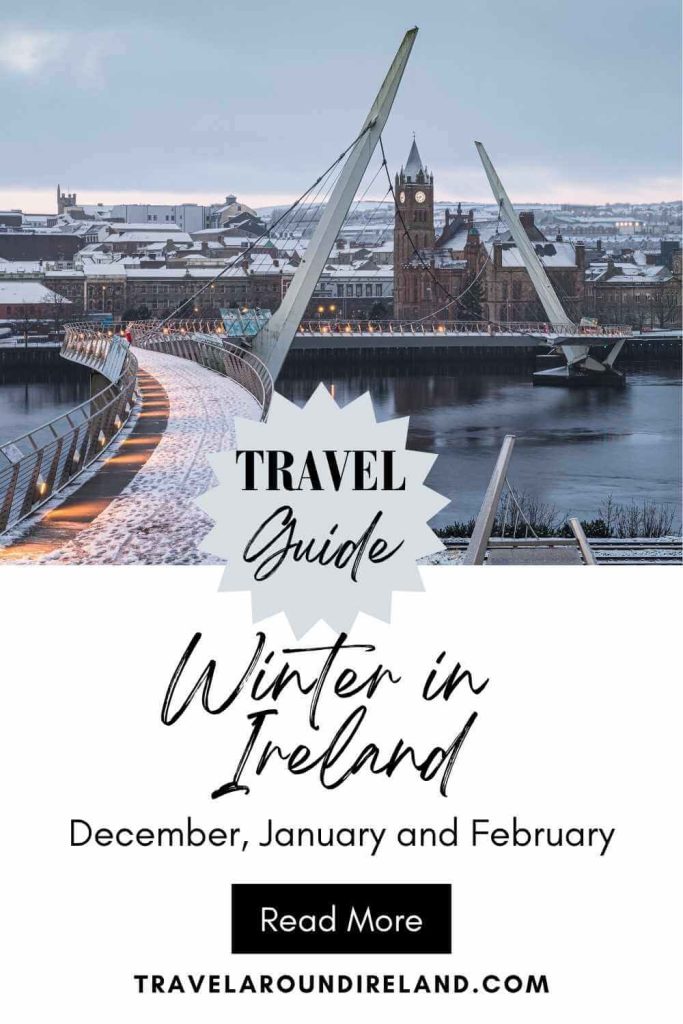
When is Winter in Ireland?
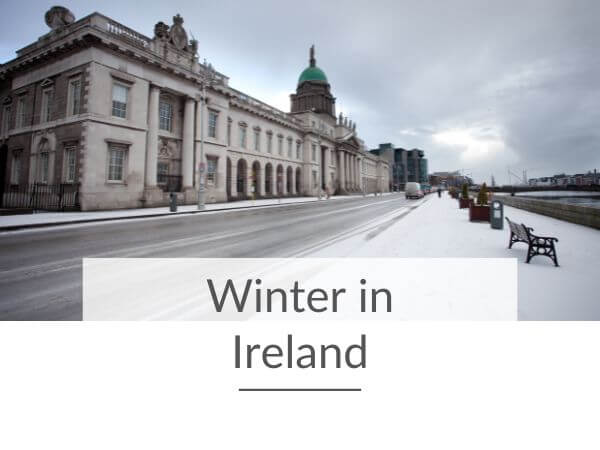
Winter in Ireland runs from December 1st through February 28th, following the traditional Celtic seasonal calendar.
These three months represent Ireland’s quietest period for tourism, with the lowest visitor numbers, the most affordable accommodation, and a landscape that is stripped back and dramatic in a way that is quite different from the lush greens of summer.
Don’t get me wrong. There is still plenty of green on the ground, it’s just some trees that are bare.
Here is what each of the three winter months looks like in practice:
December in Ireland
December is the most visited of the three winter months, largely because of Christmas.
Irish cities and towns transform in December with Christmas markets, light displays, festive events, and a warmth and conviviality that fills every pub and restaurant. Temperatures typically range from 4°C to 9°C (39°F to 48°F), and while it is cold and often rainy, the festive atmosphere more than compensates.
The Ireland in December guide covers what to do and where to go across the month, and the December packing guide will make sure you are dressed for the cold. For the full picture on Christmas in Ireland specifically, see the dedicated Christmas section below.
January in Ireland
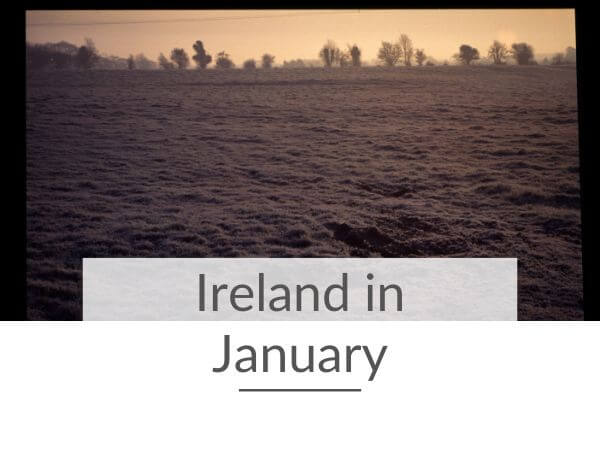
January is Ireland’s quietest month of the year for tourism, and for visitors who are comfortable with cold, short days, that quietness is genuinely appealing.
The post-Christmas lull means hotels and guesthouses are at their most affordable, popular attractions have almost no queues, and the whole country has a peaceful, unhurried quality that is the polar opposite of the summer rush.
Temperatures in January typically range from 3°C to 8°C (37°F to 46°F). It is Ireland’s coldest month on average, and also one of the wettest. That said, January can surprise you with bright, crisp days when the winter light over the Irish countryside is extraordinary.
See the January in Ireland guide for the full picture, and the January packing guide for what to bring.
February in Ireland
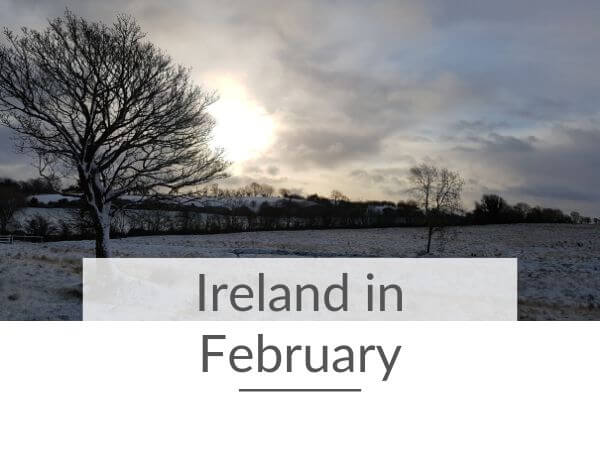
February is the final month of Irish winter, and by its end the first signs of spring are already appearing. Snowdrops begin to emerge in late February, daylight is noticeably longer than in December, and there is a sense that the worst of the cold is behind you.
Temperatures are similar to January, ranging from 4°C to 9°C (39°F to 48°F), but the improving light makes February feel significantly more optimistic.
Valentine’s Day in February is a popular occasion for short breaks to Ireland, particularly to romantic destinations like Kinsale in Cork, Westport in Mayo, or a cozy country house hotel anywhere in the country.
The February in Ireland guide covers what to expect across the month, and the February packing guide covers how to dress for the tail end of winter.
Winter Weather in Ireland: What to Expect
Ireland’s winter weather is cold, wet, and frequently dramatic, but rarely as extreme as visitors from colder climates might expect. The Gulf Stream keeps Ireland’s temperatures surprisingly mild by European standards.
While a January day in Dublin might be cold and grey, it is unlikely to be the kind of biting cold you would experience in New York, Chicago, or most of northern Europe at the same time of year.
That said, Irish winter wind is a force unto itself. On the west coast in particular, Atlantic storms can arrive with little warning and bring fierce winds and driving rain that make outdoor activities difficult. The upside is that these storms also produce some of the most spectacular coastal scenery imaginable; huge Atlantic swells, waves crashing over headlands, and a raw, elemental wildness that is quite unlike anything you see in summer.
My Top tip: Dress for wind, not just cold.
The biggest mistake winter visitors to Ireland make is packing for cold temperatures but not for wind. A lightweight down jacket might keep you warm in still conditions, but on the west coast in January it will be useless in a gale. A windproof, waterproof outer layer is non-negotiable. Everything else can be layered underneath.
Does it Snow in Ireland?
This is one of the most common questions visitors ask about Irish winter, and the answer is: occasionally, but not reliably.
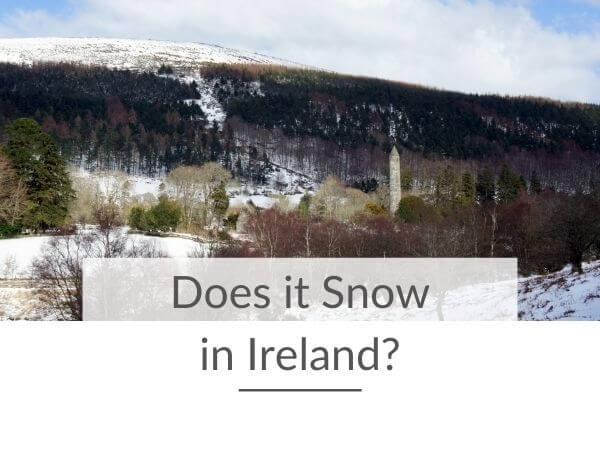
Ireland’s mild maritime climate means snow is far less common than its latitude might suggest. When it does snow, it tends to be brief, a day or two at most in most years, and it is most likely to fall in inland areas and at higher elevations rather than in coastal cities like Dublin or Cork.
That said, some years there have been significant snowfall in the latter half of winter but these are few and far between.
The full answer is more nuanced than a simple yes or no, and my does it snow in Ireland guide covers the topic in detail, including which parts of Ireland are most likely to see snow, which months it is most common, and what to do if you happen to be visiting during one of Ireland’s occasional white winters. The short answer: do not plan a trip to Ireland specifically for snow, but do not be surprised if you get a dusting during the winter months.
Christmas in Ireland
Christmas is Ireland at its most magical. Irish cities come alive with markets, lights, carol singers, and a festive warmth that fills every street and pub from late November through to the new year.
Christmas is deeply embedded in Irish culture. It is a time for family, for returning home, and for the particular kind of welcome that the Irish do better than almost anyone.
Dublin’s Christmas markets and light displays are spectacular, but the smaller cities and towns are often even more charming. Kilkenny, Galway, and Cork all host excellent Christmas events with a more intimate atmosphere than the capital.
The Christmas in Ireland mini-guide covers everything you need to know about experiencing Christmas in Ireland, from the best markets, festive events, traditions, and practical tips for planning a Christmas visit.
Book accommodation early for Christmas and New Year.
Christmas week and New Year’s Eve are among the busiest periods of the year in Irish cities. Dublin, Galway, and Cork in particular fill up quickly. If you are planning a visit over the festive period, book accommodation as early as possible – three to six months ahead is not unreasonable for popular destinations.
Why Winter is Worth Visiting Ireland
Winter is Ireland’s best-kept travel secret. Here is why it deserves more credit than it gets:
- Lowest prices of the year. Accommodation, flights, and car rental are all significantly cheaper in January and February than at any other time of year. The same money goes much further in winter.
- No crowds. Popular attractions that require advance booking in summer, such as Newgrange, Kilmainham Gaol, the Cliffs of Moher, are easily accessible in winter with little or no waiting.
- The pubs are at their best. An Irish pub in winter, with an open fire, a pint of Guinness, and a traditional music session, is one of the great travel experiences in the world. There is no better season to experience it. Pair all that with a warming seafood chowder and you’ve got the perfect Irish experience.
- Dramatic landscapes. Ireland’s coastline and countryside in winter have a raw beauty that summer simply cannot match. Atlantic storms, winter light, and empty roads through the mountains make for extraordinary travel.
- Authentic Ireland. In winter, the tourist infrastructure steps back, and you encounter Ireland more as the Irish experience it. That authenticity is something no amount of summer sunshine can replicate.
What to Pack for Winter in Ireland
Packing for an Irish winter requires a simple principle: warmth, wind-proofing, and waterproofing. The cold in Ireland is damp rather than dry, which means it feels colder than the thermometer suggests. Coming from a warmer climate, I really feel the winter chill in my bones.
Layering is essential. A thermal base layer, a warm mid-layer, and a windproof waterproof outer layer will cover almost any conditions you are likely to encounter.
Sturdy, waterproof footwear is also non-negotiable. Wet pavements, muddy walks, and sudden downpours mean that trainers or canvas shoes will leave you cold and miserable within the first day.
For month-specific packing lists, see: what to pack for Ireland in December, what to pack for Ireland in January, and what to pack for Ireland in February. Each is tailored to the specific conditions and temperatures of that month.
Ready to Plan Your Winter Trip to Ireland?
Start with the Ireland Travel Planning guide to build your itinerary, then browse ready-made Ireland itineraries for route ideas that work well in the quieter months. For accommodation, the Where to Stay in Ireland guide covers your options; winter is the easiest season to find excellent availability at genuinely good prices.
Ireland in winter is cold, quiet, and completely wonderful. Pack well, embrace the weather, find a pub with a fire, and let the country do the rest. It never disappoints.
Click to read more.